-240x180w.jpg)
Introduction
Lithium batteries power almost everything around us today – smartphones, laptops, e-bikes, solar storage systems, and even electric cars.
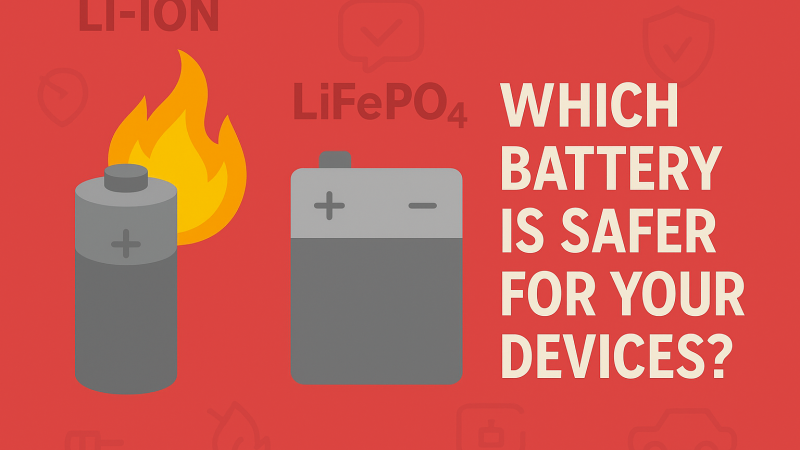
Among the many chemistries available, the two most frequently compared are Li-ion (Lithium-ion) and LiFePO₄ (Lithium Iron Phosphate).
Both have their strengths and weaknesses, but the key question remains: which one is safer?
? Key differences between Li-ion and LiFePO₄
Li-ion and LiFePO₄ batteries use different chemistries, which directly affects their capacity, lifespan, and safety profile.
Comparison Table
| Parameter | Li-ion (NMC/NCA/LCO) | LiFePO₄ (LFP) |
|---|---|---|
| Nominal Voltage | 3.6 – 3.7 V per cell | 3.2 – 3.3 V per cell |
| Energy Density | 150 – 250 Wh/kg (higher) | 90 – 160 Wh/kg (lower) |
| Cycle Life | 800 – 1500 cycles | 2000 – 5000 cycles |
| Safety | Higher risk of thermal runaway | Very stable chemistry, low fire risk |
| Temperature Resistance | Moderate (struggles in heat) | Excellent – tolerates heat/cold |
| Common Uses | Phones, laptops, e-bikes, EVs | Solar storage, industrial batteries, EVs (BYD, Tesla base models) |
| Price | Lower (mass production) | Slightly higher |
? Safety – the biggest difference
-
Li-ion batteries: while energy-dense, they are more prone to thermal runaway – an uncontrollable chain reaction triggered by overheating, overcharging, or damage, leading to fire or explosion.
-
LiFePO₄ batteries: are renowned for their stability and safety. Their chemistry makes them much less likely to catch fire, which is why they are increasingly popular in solar storage systems where safety is critical.
⏳ Lifespan and maintenance
-
Li-ion: shorter lifespan, typically 800 – 1500 cycles. Capacity degrades faster under heavy use.
-
LiFePO₄: long cycle life of 2000 – 5000 cycles, lasting 10+ years. Ideal for systems that are charged and discharged daily, such as photovoltaics.
? When to use Li-ion and when LiFePO₄
-
Li-ion:
-
Best when high capacity and low weight are required (phones, laptops, e-bikes).
-
Suitable for applications prioritizing performance over long-term durability.
-
-
LiFePO₄:
-
Best when safety and long lifespan are the priority (solar storage, industrial backup, residential battery boxes).
-
Perfect for systems that cycle daily and need to last many years.
-
?️ How to increase safety for both battery types
Even though LiFePO₄ is safer, no battery is completely risk-free. To minimize fire risks:
-
Use a high-quality BMS (Battery Management System).
-
Ensure good ventilation and proper installation.
-
Add automatic fire suppression systems.
? Solutions like LiGUARD activate automatically at high temperatures and suppress fires in just a few seconds – whether it’s Li-ion or LiFePO₄.
Conclusion
Both chemistries have their place:
-
Li-ion excels in compactness and energy density.
-
LiFePO₄ wins in safety, longevity, and thermal stability.
But when it comes to protecting homes, businesses, or large-scale battery storage, the final answer is clear:
automatic battery fire suppression systems such as LiGUARD.